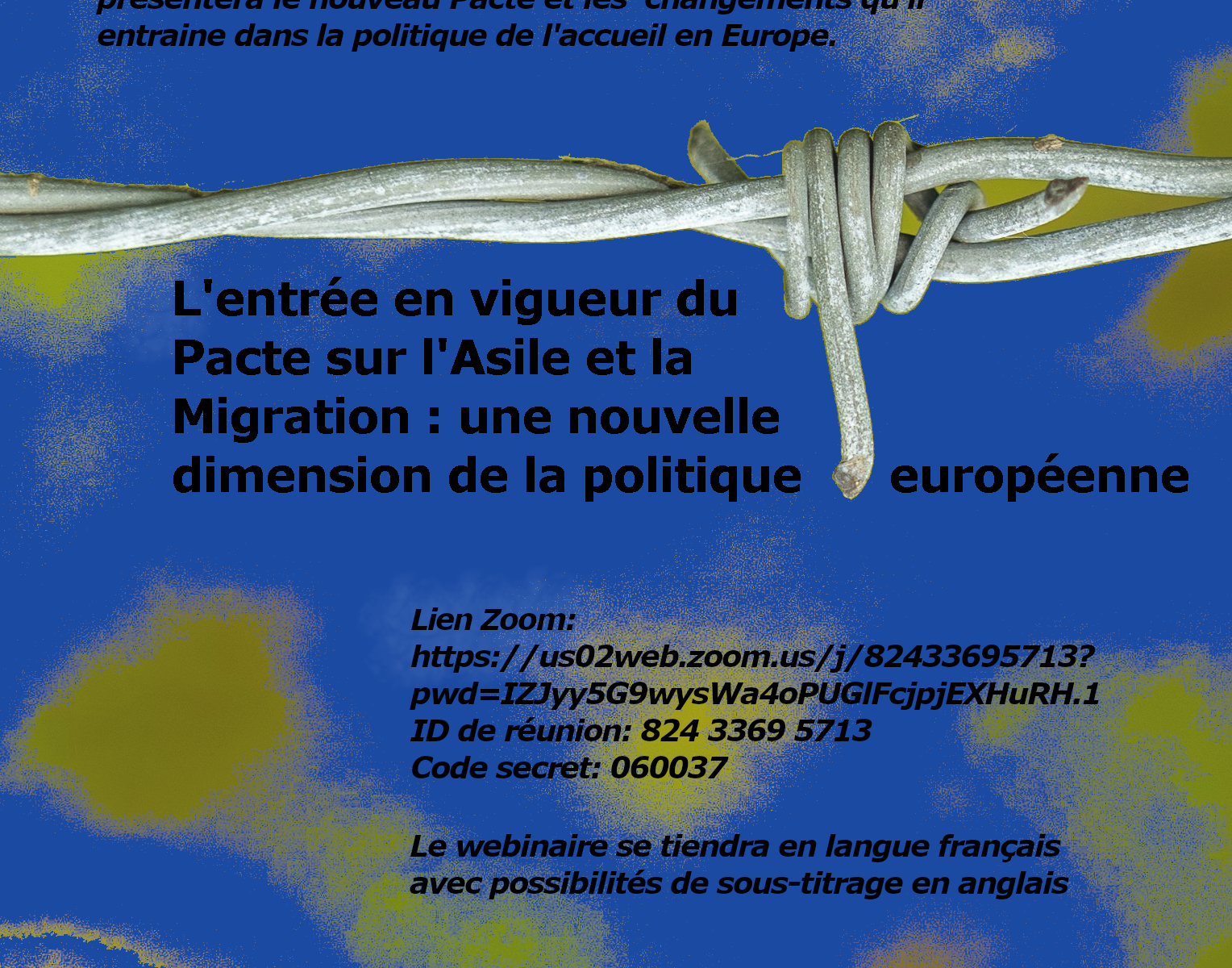
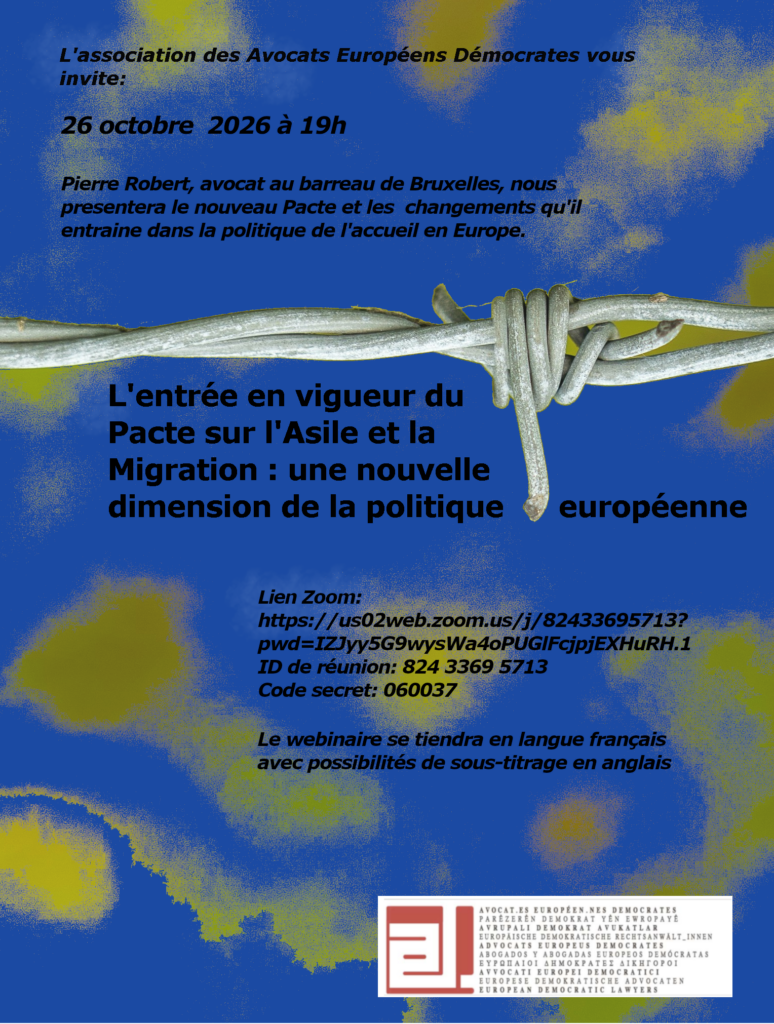
L’AED vous invite à un webinaire sur le Pacte Européen de Migration avec l’avocat Pierre Robert du barreau de Bruxelles qui nous présentera le nouveau Pacte et les changements qu’il entraine dans la politique d’asile en Europe
Lien Zoom:
https://us02web.zoom.us/j/82433695713?pwd=IZJyy5G9wysWa4oPUGlFcjpjEXHuRH.1
ID de réunion: 824 3369 5713
Code secret: 060037
Date 29th september 2023
Time : 15h-18h
Place : La Fleur en Papier Doré, Rue des Alexiens, 53-55 à 1000 Bruxelles
Price: free
Legal aid, as the provision of assistance to people who are unable to afford legal representation and access to the court system, is regarded as central in providing access to justice. Legal aid ensures equality before the law, the right to counsel and the right to a fair trial.
Legal aid is essential to guaranteeing equal access to justice for all, but the practical application of this guarantee differs from country to country. The speakers of the colloque are working lawyers in the Netherlands, Spain, Belgium, France, Germany, Greece and Turkey, confronted in their professional experience with legal aid, and will explain its functioning in the law and in the everyday praxis.
Through the presentation and analysis of these different national systems of legal aid, this initiative aims at exchanging strengths and weaknesses of the models and thus at elaborating minimal standards for legal aid. Legal aid, which can effectively provide assistance for those in need.
15h00 : Introduction, by Hélène DEBATY 15h15: Legal aid system in the Netherlands. Speaker: Sturla SPANS 15h30: Legal aid system in Spain. Speakers: Gorka VELLE BERGADO and Blanca DOMINGUEZ PARRA 15h45: Legal aid system in Belgium. Speaker Aurore LEBEAU 16h00: Legal aid system in France. Speaker Bénédicte MAST 16h 15-16h30: Break 16h 30: Legal aid system in Germany: Julius BECKER 16h45 : Legal aid system in Greece: Giota MASSOURIDOU 17h00 : Legal aid system in Turkey: Gulsah KURT 17h 15: Questions 17 h 30: Conclusions, by Hélène DEBATY
Moderation of the event: Margherita d’Andrea, lawyer: presentation of speakers and thematic
thread of the afternoon
15h00 – 15h30
Greetings
1.Thomas Schmidt, Co-Secretary General
of ELDH, greetings on behalf of ELDH and AED
2.Antonio Tafuri,
Lawyer, President of the Bar Council of Naples
3.Francesco Caia, Lawyer, National Bar
Council, President of the “Osservatorio Internazionale Avvocati in pericolo”
(OIAD https://protect-lawyers.org/it/)
4.Liana Nesta,
lawyer: Introduction to the conference
16h00 – 16h45
Refugee Rights: a European Perspective
Bill Bowring, (human rights barrister)What
can be done for refugees at the European Court of Human Rights, now in crisis.
Yiota Massouridou, (lawyer, Secretary
General of AED) The Hot-Spot System and
Pushbacks
Danilo Risi, (Laywer, executive Committee of
“Associazione Nazionale Giuristi Democratici”):
Ucrainian Refugees and effects of
the mission of Giuristi Democratici and Mediterranea NGO from Naples to Poland:
the national petition for the right of conscientious objection of Ukrainian men
16h45 – 17h00 Break
17h00 – 18h45
Refugee Rights in Italy
9.Luigi
Migliaccio, (Lawyer, member of the Commission on migration law of Bar
Council of Naples and Commission of Human Rights Union des Avocats Européens – UAE):
Family Reunification, latest jurisdiction
10.Francesco
Priore, (Lawyer, Executive Committee of “Associazione Nazionale Avvocato di
Strada”): Complementary protections to the international protection
11.Nicola
Canestrini (Lawyer): The Iuventa case
18h45 – 19h30
An activist’s perspective
12.Simona
Talamo, activist
13.Abdel
El Mir, activist, Movimento Migranti e Rifugiati Napoli
Closing remarks: Hanno Bos,
on behalf of AED & ELDH) Refugee
Rights in Europe – The Massinflux Directive – Double Standards
or a new progressive approach
The issue of the use of
technology in justice is not new – the intrusion of the scientific police and
the use of anthropometric methods dating back to the late 19th
century.
But the considerable advances
in digital technologies in recent years have led to the systematization of
these technologies in the methods of policing and justice. This includes both
intelligence methods as opposable evidence and the use of algorithmic data
processing as an aid to judges’ decision-making and, in some cases, to replace
justice.
The use of these technologies,
presented as an inescapable advance in the service of truth, necessarily raises
the question of the contradictory and equality of the parties and weapons in
litigation.
The aim of the symposium is
therefore to confront these technologies with the fundamental principle of the
contradictory.
It is also important to us
that this symposium can highlight the solutions that lawyers have been able to
find, in specific cases, to prevent the use of technology from preventing any
conflicting debate.
PROGRAMME
14h00:
Welcome Address
Estellia ARAEZ (SAF – President)
Berenice BÖHLO (AED / EDL – Copresident)
14h15:
1/ Introduction: Quick state
of affairs in different countries
The implementation of new technologies
Volker EICK (political scientist – RAV)
14h30
2/ Justice and algorithmic
treatment
From aiding the decisión
of judges to their complete replacement
Medical expertise – (DNA), information – eavesdropping – telephony, access
to private data, facial recognition, place of experts and challenge to their
quality
Guillaume MARTINE (French criminal lawyer)
Andreu VAN den EYNDE (Catalan criminal lawyer)
DEBATE
MODERATOR: Angeles CHINARRO PULIDO (Lawyer)
17h00: Coffee Break
17h30:
4/ Virtual audiences,
dematerialization
Virtual audiences, anonymous testimonials and other current
dematerialization of a fair trial.
M. Buket SOYGUT ARSLAN (Turkish Academic)
Fulya EROGLU (Turkish Academic)
Christian LICOPPE (Researcher at Telecom Paris)
DEBATE
MODERATOR: Ceren UYSAL (Lawyer).
19h30:
6/ Conclusion: the means of
the contradictory
How to ensure equality of arms
Jose Luis MUGA MUÑOZ (AED/EDL – Copresident)
Justice, Technologie et le principe
du contradictoire
Paris, 15Octobre 2021
Auditorium Gaston Monnerville, Maison du Barreau – 2 rue de Harlay – 75001 Paris
Traduction Français – Anglais
LIVE PAR ZOOM
Une préinscription est en place pour éviter les attaques de spam. Merci
La question de l’utilisation des technologies dans la justice n’est pas nouvelle – l’irruption de la police scientifique et l’utilisation des méthodes anthropométriques datant de la fin du 19° siècle.
Mais les progrès considérables des technologies numériques ces dernières années entrainent une systématisation de ces technologies dans les méthodes de police et de justice. On pense ainsi tant aux méthodes de renseignement comme preuves opposables que l’utilisation du traitement algorithmique des données comme aide à la décision des juges voire, dans certain cas, pour remplacer la justice.
L’utilisation de ces technologies, présentées comme un progrès inéluctable au service d’une vérité, pose nécessairement la question du contradictoire et de l’égalité des parties et des armes dans les contentieux.
Le colloque a donc pour objectif de confronter ces technologies au principe fondamental du contradictoire.
PROGRAMME
14h00:
Allocution de bienvenue
Estellia ARAEZ (SAF – Présidente)
Berenice BÖHLO (AED / EDL – Coprésidente)
14h15:
1/ Situation dans différents pays
La mise en place de nouvelles technologies
Volker EICK (RAV)
14h30
2/ Justice et traitement algorithmique
De l’aide à la décision des juges à
leur remplacement complet
Antoine GARAPON (Juge)
Guillem SOLER SOLÉ (Juge- AGORA judicial)
DEBAT
MODERATEUR: Juan PROSPER (Avocat)
16h00
3/ Les soi-disant preuves indiscutables
Expertise médicale – (ADN), information – écoute – téléphonie, accès aux
données privées, reconnaissance faciale, place des experts et défi à leur
qualité
M. Guillaume MARTINE (avocat, droit penale)
Andreu VAN den EYNDE (Catalan criminal lawyer)
DEBAT
MODERATRICE: Angeles CHINARRO PULIDO (Avocat)
17h00: Pause café
17h30:
4/ Audiences virtuelles, dématérialisation
Audiences virtuelles, témoignages
anonymes et dématérialisation du procès équitable.
This webinar-series critically highlights interesting case law, legal developments in Europe in Asylum and Migration Law. We invite Lawyers to present interesting cases in order to share experiences and connect. We want to discuss the legal arguments but also the political context.
The aim of these webinars is to share practical experiences and to start a European, and global, communication amongst Lawyers concernig Migration and Asylum.
We are convinced we should organise strong positions amongst Lawyers to resist Fortress Europe and for the right of the freedom of movement.
On the 20th of October, in the university of Turin the AED-EDL has organized a conference on the repression of social movements and counter practices in Europe.