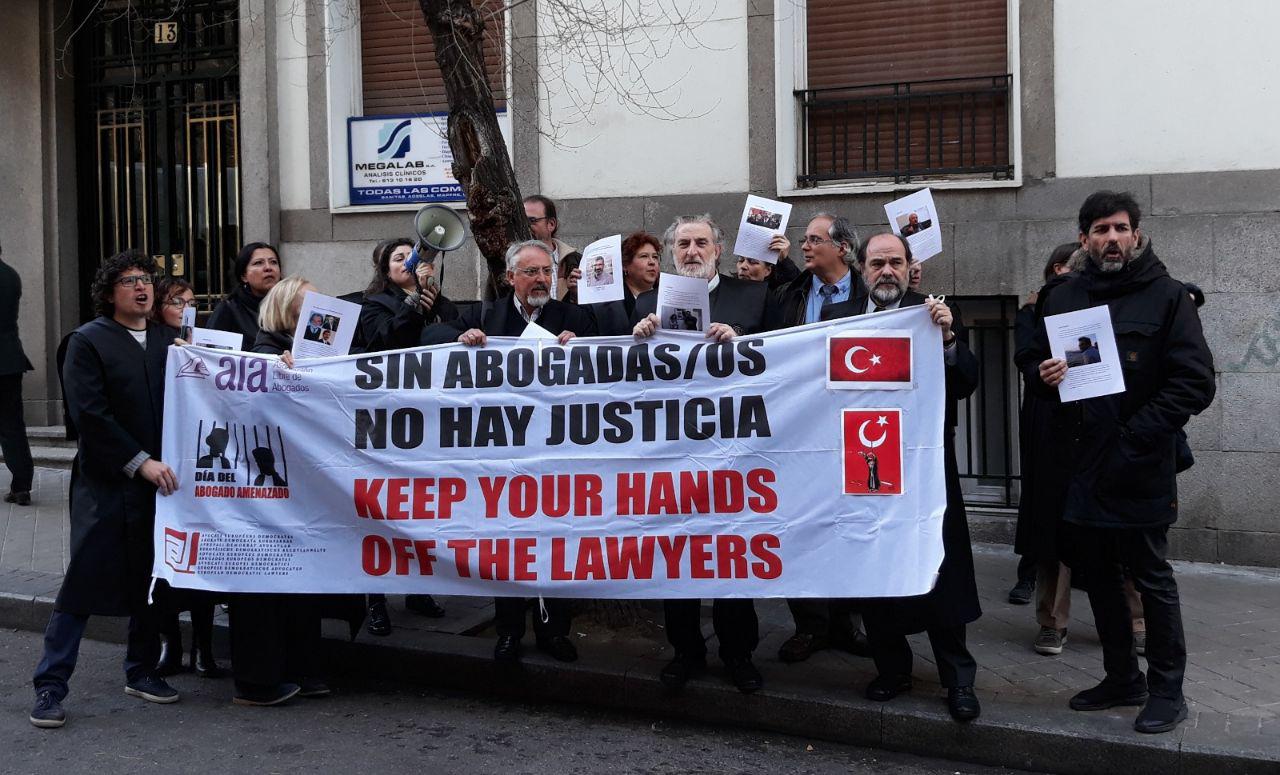
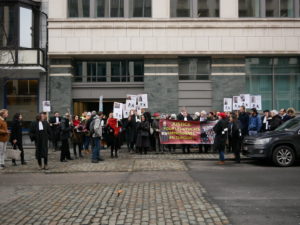
The AED has co-signed a letter directed at the UN denouncing the arbitrary detention and long-term imprisonment of 18 lawyers. We publish it here to explain the mechanisms of their judicial situation:
FOR THE ATTENTION OF:
- Special Rapporteur on the independence of judges and lawyers
- Special Rapporteur on the situation of human rights defenders
- Special Rapporteur on the promotion and protection of the right to freedom of opinion and expression
- Special Rapporteur on the promotion and protection of human rights while countering terrorism
Dear Madam/Sir:
URGENT ACTION: The arbitrary detention and long-term imprisonment of 18 lawyers from Halkın Hukuk Bürosu (HHB, the Peoples’ Law Office) and Ҫağdaş Hukukçular Derneği (ҪHD, the Progressive Lawyers Association) in violation of fair trial principles and of their rights to freedom of expression.
BACKGROUND
- On 15 July 2016, a faction of Turkey’s armed forces staged a violent coup attempt which resulted in the deaths of over 200 and injuries to over 2,000 people.[1] Following the attempted coup, the Government of Turkey (Government) declared a three-month state of emergency to commence on 21 July 2016. The state of emergency was later extended seven times (by three month increments each time) and eventually ended on 19 July 2018.[2] The state of emergency exacerbated the “purge” of State organs and civil society of those allegedly connected to the “Gülen movement”[3] (who were blamed by the Government for the coup attempt) and supporters of the opposition critical of the Government. Mass dismissals of public servants took place without due process amounting to hundreds of thousands including judges, prosecutors, police, military personnel and academics as well as forced closures of media outlets, civil society organisations, universities and trade unions.[4] Human rights defenders (including lawyers), journalists and NGO members who had sought to expose rights violations have been persecuted and often arbitrarily detained and imprisoned.[5] The common thread is, under the guise of national security arguments, the suppression and criminalization of all expression or association of those who are perceived to potentially express, inspire or support criticism of state action or expose state wrongdoing.
- The independence and impartiality of the judiciary has been substantially undermined by legislative and constitutional amendments (both pre and post-coup) which have increased executive influence over the judiciary. The judiciary now lacks the capacity to ensure a robust system of justice and uphold the rule of law, especially with reference to remedies for human rights violations by state actors flowing from the state of emergency measures.[6]
- Further eroding the rule of law and justice, the Government has adopted a sustained practice of targeting members of the legal profession and interfering with their ability to perform their roles as a key part of the justice system.[7] The Government has prevented lawyers from performing their legitimate duties as lawyers by restricting access to case files and indictments, limiting clients’ access to their lawyers and committing breaches of legal professional confidences including by observing and recording confidential meetings with clients.[8] Lawyer/client visits have also been restricted.
- The rights of individuals accused of terrorist crimes to retain legal counsel while in pre-trial detention and to prepare their defence have been largely restricted since the coup attempt, including the right to privileged communication with their lawyer. As stated recently by a lawyer interviewed for a report on the situation of lawyers in Turkey,“[a]s a lawyer you meet your client in prison, and you have no possibility of confidential communication since there’s a prison guard present, a microphone and a camera.”[9] Concerns have also been raised regarding the principle of equality of arms between the prosecution and the defendant as the defendant’s lawyers’ role is significantly subverted and almost reduced to the simple formality of appearing at the court proceeding.
- The Government has also interfered with the legal profession through the persecution of lawyers, both by way of intimidation but also through arbitrary arrests, detention, imprisonments and ill-treatment.[10] Several lawyers interviewed for the report mentioned above reported threatening remarks from police officers when they visited detainees in police station such as: “Watch out. Representing these suspects could be bad for you” and “It’ll be your turn next”.[11]
- Targeted lawyers (and many other members of civil society) have been charged with terror related offences such as membership in a terrorist organisation, forming and leading a terrorist organisation and aiding and abetting a terrorist organisation under Articles 314 and 220 of the Turkish Penal Code. The overly broad language and criteria used in these Articles has led to arbitrary convictions and arbitrarily imposed terms of imprisonment preventing the lawyers from carrying out their role effectively as one of the main pillars of the justice system.[12]
- The Office of the High Commissioner for Human Rights (OHCHR), among other bodies, has “identified a pattern of persecution of lawyers representing individuals accused of terrorism offences”.[13] The principle of non-identification of lawyers with their clients and their causes required by the UN Basic Principle on the Role of Lawyers[14] has been undermined by the Turkish authorities. A lawyer described this situation by stating that “If a lawyer defends a Kurd these days that makes him a Kurdish nationalist. If he defends a FETÖ suspect, he is a FETÖ member”.[15]
- The UN Special Rapporteur for the Promotion and Protection of Human Rights while Countering Terrorism, following a 2006 visit in Turkey, had criticized the vague definition of terrorist crimes for not being in line with international norms and standards and warned that “only full clarity with regards to the definition of acts that constitute a terrorist crime can ensure that the crime of membership, aiding and abetting and what certain authorities refer to as ‘crime of opinion’ are not abused for purpose other than fighting terrorism.”[16] Since the 2016 coup attempt, these overly broad and vague laws have been used to illegitimately investigate, prosecute and/or convict upwards of 402,000 individuals as of January 2019. [17] Among those individuals, lawyers were specifically targeted: 1,546 lawyers have been prosecuted under these provisions, 598 arrested and 274 convicted and sentenced to long term prison sentences ranging from 2 to 18 years.[18] There have been recent reports that this persecution of lawyers has now been extended to covert State investigations into those lawyers’ families, including their children and spouses.[19] Lawyers in Turkey are being persecuted for simply performing their constitutionally protected roles peacefully and lawfully. They are prosecuted, and often convicted, based on vague definitions of terrorism and related acts. The arbitrary application of these laws to silence and intimidate human rights defenders and lawyers lawfully exercising their right to freedom of expression, among other fundamental human rights, has been vividly present.[20] Following the declaration of the state of emergency, 1,719 human rights, humanitarian, and lawyers’ associations, foundations and NGOs were permanently closed by the Government.[21] This threatening and harassing climate has subsequently compelled human rights NGOs to exercise self-censorship.[22]
CASE STUDY
- In 2016, ҪHD, which was a lawyers’ organization well known for speaking out against State repression, practices of torture and other human rights violations,[23] was forced to close by virtue of a state of emergency decree (Statutory Decree No. 677). On 12 September 2017, sixteen lawyers from HHB and ҪHD, Didem Baydar Ünsal, Şükriye Erden, Ayşegül Çağatay, Ebru Timtik, Aytaç Ünsal, Zehra Özdemir, Yağmur Ereren, Engin Gökoğlu, Süleyman Gökten, Aycan Çiçek, Naciye Demir, Behiç Aşçı, Barkın Timtik, Özgür Yılmaz, Ahmet Mandacı and Ezgi Gökten were taken into custody on the basis of allegations that they were members of or leading members of the Revolutionary People’s Liberation Party-Front (DHKP-C), a Turkish Marxist-Leninist Party which Turkey considers an armed terrorist organization.[24] All sixteen lawyers were representing Nuriye Gülmen and Semih Özakça, an academic and a teacher respectively, who had engaged in public protests and went on a hunger strike objecting to dismissals from their jobs facilitated by a state of emergency decree. The defence lawyers were arrested two days before Gülmen and Özakça’s trial started. Fifteen out of the sixteen lawyers were remanded in custody on 21 September 2017. The chair of ÇHD, Selçuk Kozağaçlı, was arrested on 8 November 2017 and remanded in custody on 13 November 2017.[25] Yaprak Türkmen was taken into custody on 18 December 2017 under the same investigation file; she was kept in custody for 2 days and her pre-trial detention was ordered on 20 December 2017 by an Istanbul Criminal Judgeship of Peace.[26]
- In total, twenty lawyers were accused of being members or leaders of DHKP-C and the pre-trial detention of 17 was ordered. An indictment was then prepared by the Istanbul Public Prosecutor and issued on 22 March 2018. On 14 September 2018, the Istanbul 37th Heavy Penal Court ordered the release of all 17 detained lawyers, Ahmet Mandacı, Aycan Çiçek, Ayşegül Çağatay, Aytaç Ünsal, Barkın Timtik, Behiç Aşçı, Didem Baydar Ünsal, Ebru Timtik, Engin Gökoğlu, Naciye Demir, Özgür Yılmaz, Selçuk Kozağaçlı, Süleyman Gökten, Şükriye Erden, Yağmur Ererken, Yaprak Türkmen and Zehra Özdemir. However, less than 24 hours after their release, the Prosecutor’s Office objected to the release of the lawyers.[27] The court panel issued a new arrest warrant for 12 of the 17 lawyers who were previously released. By the second week of December, six of them were arrested again.[28] On 19 September 2018, two judges of the court that had ordered pre-trial release on 14 September 2018, including the presiding judge, were replaced by two new judges.
- The “trial” of the lawyers, six of whom had been held in pre-trial detention, occurred in three hearings. The third and final hearing was held between 18 March and 20 March 2019 at the Istanbul 37th Heavy Penal Court in Silivri Courthouse. The lawyers were convicted of terrorism offences linked to DHKP-C and sentenced to prison terms. The court reaffirmed the Public Prosecutor’s conclusion, that by providing legal representation to individuals charged with links to the outlawed DHKP-C, the lawyers became themselves members of the illegal group.[29]
- The names of the lawyers, the charges they faced and the subsequent sentences they received are as follows:
- For “willingly and knowingly aiding a terrorist organization,” under Articles 314(3) and 227(2) of the Turkish Penal Code: Ayşegül Çağatay, Yağmur Ereren, Didem Baydar Ünsal, Yaprak Türkmen: 3 years 9 months; Ahmet Mandacı, Zehra Özdemir: 2 years 13 months, and 15 days imprisonment.
- For “membership of a terrorist organization” under Article 314(2) of the Turkish Penal Code: Ebru Timtik, Özgür Yılmaz 13.5 years; Behiç Aşçı, Sukriye Erden: 12 years; Selçuk Kozağaçlı (ÇHD President): 11 years and 3 months; Suleyman Gokten, Aytaç Ünsal, Engin Gökoğlu: 10.5 years; Aycan Çiçek, Naciye Demir: 9 years; Ezgi Cakir: 8 years imprisonment.
- For “founding and managing a terrorist organization” under Article 314(1) of the Turkish Penal Code: Barkın Timtik: 18 years and 9 months imprisonment.
- The trial was plagued by a distortion of procedural process and lack of respect for universally accepted elements of a fair trial which have been criticised by Amnesty International as “a travesty of justice [that] demonstrate yet again the inability of courts crippled under political pressure to deliver a fair trial”.[30] Such concerns included arguments by the prosecution based on digital records which were not in the case file and not made available to the defence, and the judge not allowing the defence to speak or to engage in any effective manner to challenge evidence and refusing a request to facilitate the collection of further evidence and investigation.[31] The judges also interrupted a request by the defence for the recusal of the presiding judge, they did not allow them to finish their submission and then had all the defendants and their lawyers removed from the court. The sentences were issued the following day without the defendants and their lawyers being allowed to return to court to submit their final defence statements and participate further in the proceedings.[32]
- Representatives of bar associations in Turkey, as well as a number of international lawyers’ organisations, attended the final hearing.[33] Subsequently, a statement formulated by 39 bar associations across Turkey condemned what they referred as “repeated violations of the right to a fair trial, of the criminal procedure code and of principles of the law by the court.”[34] The international monitors drafted reports similarly criticizing the way the trial had been conducted by the court.[35]
TURKEY’S OBLIGATION UNDER DOMESTIC AND INTERNATIONAL LAW
Right to Liberty and Security and Right to a Fair Trial
- Domestic law: The right to liberty and security, protecting an individual’s right not to be arbitrarily deprived of liberty, is recognised under the Constitution of Turkey (Constitution).[36] Article 19 of the Constitution protects everyone’s right to liberty and security: according to paragraph 3, conditio sine qua non for a lawful arrest is the presence of strong evidence of the commission of a crime. Article 90 of the Constitution provides that international agreements concerning fundamental rights and freedoms, such as the International Covenant on Civil and Political Rights (ICCPR) and the European Convention on Human Rights (ECHR), “duly put into effect carry the force of law.”
- Moreover, under Article 100 of the Turkish Code of Criminal Procedure,[37] a pre-trial detention can be carried out only if facts show the existence of a strong suspicion of a crime and one of the listed grounds for arrest is present. Such grounds are as follows: specific facts supporting the suspicion that the suspect or accused is going to flee; suspicion that the suspect or the accused will attempt to destroy, hide or alter the evidence, or will attempt to put pressure on witnesses, victims or other individuals.
- International law: The right to liberty and security is protected under existing human rights law instruments, both at an international and at a regional level. Article 9 of the Universal Declaration of Human Rights (UDHR),[38] Articles 9 and 14 of the ICCPR,[39] and Article 5 of the ECHR[40] guarantee everyone’s right to liberty and security and prohibit any arbitrary violation of such rights, with Article 14 of the ICCPR laying out fair trial standards.
- The main aim of the abovementioned provisions is to protect individuals from arbitrary deprivation of liberty. Thus, any substantive grounds for arrest or detention must be “prescribed by law” with sufficient precision to prevent arbitrariness. Even if an arrest or detention has legal basis and is administered following the procedures established by domestic law, it may still be arbitrary unless it is reasonable, necessary and proportionate. The notion of “arbitrariness” therefore is a broader concept which includes “elements of inappropriateness, injustice, lack of predictability and due process of law, as well as elements of reasonableness, necessity and proportionality.”[41] The UN Human Rights Committee notes that detention as punishment for the legitimate exercise of the rights of freedom of opinion and expression, freedom of assembly or freedom of association is considered to be arbitrary. Similarly, deprivation of liberty pursuing an aim of intimidation or reprisal against a person is also arbitrary.[42]
- Application of the law: The arrest and subsequent detentions of the lawyers detailed above are unlawful both under Turkey’s domestic laws and the State’s international human rights obligations. In light of the State rhetoric[43] surrounding the lawyers’ defence of Nuriye Gülmen and Semih Özakça and other work criticising the Government’s human rights violations, this trial and resulting imprisonments seem to be a tool to harass lawyers, as they are being prosecuted and punished merely for carrying out their professional obligations. In addition, their arrests, detention and sentencing constitute an unlawful interference with the rights of their clients to petition the ECtHR under the ECHR. The lawyers are being charged and have been imprisoned for their legal activities as members of their respective associations; these are legitimate activities carried out in the course of discharging their professional duties. Moreover, legal representation cannot be used as a tool to identify lawyers with their clients or their clients’ causes.[44] To allow lawyers to be identified with their clients’ alleged causes is certain to discourage lawyers from defending many accused persons, thereby depriving many accused individuals of their fundamental right to a proper legal defence. The lawyers in this case have been impermissibly identified with their clients and consequently prosecuted.
- The absence of due process rights and fair trial standards in the procedure followed against the lawyers amounts to violations under Article 14 of the ICCPR, and, regarding arbitrary detention, under Article 9 of the ICCPR. Such fair trial deficiencies include the failure to allow the defence to examine prosecution evidence and witnesses and the refusal by the judge to even hear certain defence arguments (including a request that the judge be recused).[45] Under Article 14 (1) of the ICCPR, there must be equality of arms between the parties in a proceeding.[46] This principle was undermined significantly in the trial as the lawyers’ defence teams were prevented from cross-examining witnesses, as provide for under Article 14 (3)(e) of the ICCPR,[47] from accessing and actioning investigations into prosecution evidence (contrary to Article 14 (3)(b) of the ICCPR) and by the court refusing to hear defence legal arguments and then later expelling them from proceedings.[48] Article 14 3(d) of the ICCPR ensures that the accused be present during their trial and be able to defend themselves through legal representation of their choosing. The court, by removing all defendants and their legal representation towards the end of the trial and from the sentencing portion has violated this right without any objective and reasonable basis.[49] There are therefore violations of Articles 9, 14 and 19 of the ICCPR in relation to the detention and prosecution of the 18 lawyers.
Rights of Lawyers and Rule of Law
- International Law: At an international level, the rights of lawyers, including their right to liberty and security, are protected by a number of instruments including the 1990 United Nations Basic Principles on the Role of Lawyers,[50] the Draft Universal Declaration on the Independence of Justice, paragraph 7 of UN Resolution No. 2004/33/19, and Recommendation No. 21 of the Committee of Ministers to Member States on the freedom of exercise of profession of lawyer adopted by the European Council in 2000. These instruments clearly recognise the fundamental role of the legal profession in the administration of justice and maintenance of the rule of law.
- The Basic Principles on the Role of Lawyers state that lawyers’ enjoyment of the rights and freedoms recognised under international human rights instruments and relevant to their professional conduct must be respected. Accordingly, States are obliged to recognise and uphold the independence of lawyers. Principle 16 states that Governments are under obligation to ensure that no restrictions, influences, inducements, pressures, threats or interference are to be imposed on lawyers while they are discharging their professional duties. States must enable lawyers to carry out their professional activities freely, diligently and fearlessly, without any inhibition or pressure. Lawyers shall enjoy the right to take full and active part in the political, social and cultural life of their country. According to Principle 23, lawyers are entitled to freedom of expression, opinion and association. Moreover, lawyers have the right to take part in public discussions of matters concerning the upholding of international human rights “without suffering professional restrictions”.[51] Due to the increased incidents of harassment, threats and attacks against lawyers in a number of Council of Europe countries, including Turkey, and undue interference with their legitimate activities, the Parliamentary Assembly of the Council of Europe has recommended the drafting of a binding Convention for the protection of lawyers in member states,[52] taking its previous recommendation a step forward.[53]
- Furthermore, Article 9 of the United Nations Declaration on Human Rights Defenders states that “everyone has the right […] to offer and provide professionally qualified legal assistance or other relevant advice and assistance in defending human rights and fundamental freedoms”;[54] and Article 11 imposes an obligation on States to ensure everyone’s right “to the lawful exercise of his or her occupation or profession”.[55] Lastly, according to Principle 18 of the UN Basic Principles on the Role of Lawyers, “lawyers shall not be identified with their clients or their clients’ causes as a result of discharging their functions”.[56]
- Application of the law: The apprehension and detention of the 18 Turkish lawyers constitutes a serious interference with their rights and freedoms, as stipulated under the above-mentioned international instruments. By arresting and sentencing these lawyers, the Government not only prevents them from exercising their professional duties but also denies prospective or actual clients the right to be represented by a lawyer of their choice. These acts constitute a violation under both Article 6(2) of the ECHR and Article 14 of the ICCPR, as well as the above-mentioned principles stipulated under the UN Basic Principles on the Role of Lawyers including Principle 1 stating that “all persons are entitled to call upon the assistance of a lawyer of their choice”.
- This case raises issues in relation to a number of other rights and freedoms including the right to freedom of expression, association and peaceful assembly, and the right to respect for private life and correspondence of lawyers. In this submission, however, the focus has been on the above-mentioned aspects of the violations resulting from unlawful detention and prosecution of the 18 lawyers.
- Turkish State authorities are using arrests and detentions as tools to prosecute lawyers and other human rights activists for working on cases that shed light on possible human rights violations perpetrated by the Government. Such conduct by the Turkish State constitutes a breach of Turkey’s international obligation to ensure that lawyers are not being prevented from performing their professional functions freely.
ACTIONS REQUESTED
- We request the Special Rapporteurs urge the Turkish authorities to facilitate the immediate acquittal of lawyers Ayşegül Çağatay, Yağmur Ereren, Didem Baydar Ünsal, Yaprak Türkmen, Ahmet Mandacı, Zehra Özdemir, Ebru Timtik, Özgür Yılmaz, Behiç Aşçı, Sukriye Erden, Selçuk Kozağaçlı, Suleyman Gokten, Aytaç Ünsal, Engin Gökoğlu, Aycan Çiçek, Naciye Demir, Ezgi Cakir and Barkın Timtik; and the urgent release of those in detention pending appeal.
- We further request the Special Rapporteurs urge the Turkish authorities to stop all forms of harassment, including judicial harassment, against these individuals as well as other lawyers and human rights defenders in Turkey, and allow them to perform their professional and lawful functions without intimidation or improper interference.
- We request the Special Rapporteurs intervene in these serious matters and raise these issues, as a matter of priority, with the Turkish authorities. In particular, the Special Rapporteurs are requested to communicate – if possible, jointly – the concerns outlined in relation to the detention of the 18 lawyers.
- We request the Special Rapporteurs urge the Turkish authorities to immediately stop using oppressive methods against individuals, particularly lawyers and other human rights defenders, who are critical of the human rights violations perpetrated by the State authorities including the security forces.
- We request the Special Rapporteurs urge the Turkish authorities to ensure the independence of the judiciary by law and practice and to prevent judges, prosecutors and lawyers from undue interferences.
- We request the Special Rapporteurs call on the Government of Turkey to comply with the provisions of the ICCPR, the UN Basic Principles on the Role of Lawyers, the UN Declaration on Human Rights Defenders and other international instruments on the protection and promotion of fundamental rights and freedoms.
- We would be grateful if you would kindly confirm what action you will be taking and to inform us of any response received from the Turkish authorities.
- Finally, we would be grateful for your acknowledgement of receipt of this letter.
Yours faithfully,
[1]Amnesty International, No End in Sight, Purged Public Sector Workers Denied a Future in Turkey, 2017, https://www.amnesty.org/en/documents/eur44/6272/2017/en/, accessed 29 March 2019.
[2] On 9 August 2018, the lifting of the state of emergency and end of the derogation period was notified by the Turkish Government to the Secretary General of the UN, https://treaties.un.org/doc/Publication/CN/2018/CN.378.2018-Eng.pdf, accessed 29 March 2019.
[3]This movement is a collective term for those followers of the now US-based Islamic cleric Fethullah Gulen who the Turkish Government blamed for orchestrating the 2016 coup attempt.
[4]Human Rights Joint Platform, Updated Situation Report- State of Emergency in Turkey, 21 July 2016 – 20 March 2018, http://www.ihop.org.tr/en/wp-content/uploads/2018/04/SoE_17042018.pdf>\, accessed 29 March 2019.
[5] Amnesty International, Turkey: NGOs unite to defend civil society from destruction, 27 February 2019, https://www.amnesty.org/en/latest/news/2019/02/turkey-ngos-unite-to-defend-civil-society-from-destruction/, accessed 29 March 2019.
[6] See. International Commission of Jurists, Turkey: the Judicial System in Peril : A briefing paper, https://www.icj.org/wp-content/uploads/2016/07/Turkey-Judiciary-in-Peril-Publications-Reports-Fact-Findings-Mission-Reports-2016-ENG.pdf; Council of Europe Group of State Against Corruption (GRECO), Fourth Evaluation Round Turkey: Corruption Prevention In Respect of Members of Parliament, Judges and Prosecutors, 15 March 2018, https://rm.coe.int/fourth-evaluation-round-corruption-prevention-in-respect-of-members-of/1680792de8; Parliamentary Assembly of the Council of Europe, The worsening situation of opposition politicians in Turkey: what can be done to protect their fundamental rights in a Council of Europe member State?, Resolution 2260 (2019), 24 January 2019, http://assembly.coe.int/nw/xml/XRef/Xref-XML2HTML-EN.asp?fileid=25425&lang=en, accessed 29 March 2019.
[7]Human Rights Watch, World Report 2019, https://www.hrw.org/world-report/2019/country-chapters/turkey, accessed 5 April 2019.
[8] The Law Society of England and Wales, Bar Human Rights Committee of England and Wales, International Bar Association Human Rights Institute, Joint Submission to the Special Rapporteur on the Independence of Judges and Lawyers concerning International Law Breaches Concerning the Independence of Legal Profession in Turkey, 18 September 2018, p.18-30, http://www.barhumanrights.org.uk/wp-content/uploads/2018/09/bhrc-ibahri-lsew-joint-submission-turkey-final2.pdf, accessed on 5 April 2019.
[9] Human Rights Watch, Lawyers on Trials; Abusive Prosecutions and Erosion of Fair Trial Rights in Turkey, April 2019, p.6 and 8, https://www.hrw.org/sites/default/files/report_pdf/turkey0419_web.pdf, accessed 18 April 2019.
[10] Ibid.
[11] Human Rights Watch, Lawyers on Trials; Abusive Prosecutions and Erosion of Fair Trial Rights in Turkey, April 2019, p.7, https://www.hrw.org/sites/default/files/report_pdf/turkey0419_web.pdf, accessed 18 April 2019.
[12] European Commission for Democracy Through Law, Opinion on Articles 216, 299, 301 and 314 of the Penal Code of Turkey, Adopted at 106th Plenary Session, Venice, 11-12 March 2016, Opinion No. 831/2015, 15 March 2016, https://www.venice.coe.int/webforms/documents/default.aspx?pdffile=CDL-AD(2016)002-e, accessed 29 March 2019; Council of Europe Commissioner for Human Rights, Third party intervention by the Council of Europe Commissioner for Human Rights, 10 October 2017, https://rm.coe.int/third-party-intervention-10-cases-v-turkey-on-freedom-of-expression-an/168075f48f, accessed 29 March 2019.
[13] UN Office of the High Commissioner for Human Rights (OHCHR), Report on the Impact of the State of Emergency on Human Rights in Turkey, Including an Update on the South-East, March 2018, https://www.refworld.org/docid/5ab146c14.html, accessed 29 March 2019.
[14] UN Basic Principles on the Role of Lawyers, 1990, principle 18, http://www.ohchr.org/EN/ProfessionalInterest/Pages/RoleOfLawyers.aspx, accessed 5 April 2019.
[15] Human Rights Watch, fn no. 11, p.6.
[16]Report of the Special Rapporteur on the promotion and protection of human rights and fundamental freedoms while countering terrorism on his mission to Turkey (April 16-23, 2006), November 16, 2006, §90, https://documents-ddsny.un.org/doc/UNDOC/GEN/G06/149/42/PDF/G0614942.pdf?OpenElement, accessed 1 April 2019.
[17] The Arrested Lawyers Initiative, New Report: Incarceration of Turkish Lawyers: Unjust Arrests and Convictions (2016-2018), 1 April 2019, p.33, https://arrestedlawyers.files.wordpress.com/2019/04/report9.pdf, accessed 10 April 2019.
[18] Ibid., p.1.
[19] Ibid, p. 31.
[20] OHCHR, Report on the impact of the state of emergency on human rights in Turkey, fn no. 13.
[21] Ibid, p. 3, §13
[22] Ibid. p. 22, §92.
[23] Stockholm Center for Freedom, Lawyers association: Imprisoned Gülen followers subject to rape, nail extraction, object insertion, January 18, 2017, https://stockholmcf.org/lawyers-association-imprisoned-gulen-followers-subject-to-rape-nail-extraction-object-insertion/, accessed 1 April 2019.
[24] Bianet, 14 Detained Attorneys of Gülmen, Özakça on Hunger Strike Arrested, 21 September 2017, https://bianet.org/english/law/190006-14-detained-attorneys-of-gulmen-ozakca-on-hunger-strike-arrested.
[25] Bianet, Progressive Legist Association Chair Kozagacli Arrested, 14 November 2017, http://bianet.org/english/law/191498-progressive-legists-association-chair-kozagacli-arrested.
[26] European Association of Lawyers for Democracy & World Human Rights (ELDH), Summary of Trial Against 20 Lawyers, https://eldh.eu/wp-content/uploads/2019/03/SUMMARY-OF-TRIAL-AGAI%CC%87NST-20-LAWYERS.pdf, accessed 3 April 2019.
[27] A similar example was seen in a case where 29 journalists were tried for being members of a terrorist organization aftermath of attempted coup d’état. Journalists were rearrested after courts had ordered their release and the judges and a prosecutor of the case were suspended by the Supreme Board of Judges and Prosecutors (HSYK), http://www.hurriyetdailynews.com/turkeys-board-of-judges-prosecutors-temporarily-suspends-four-for-ordering-release-of-gulen-suspects-111576.
[28] Bianet, 18 Lawyers Sentenced to Prison for 159 Years, 1 Month, 30 Days in Total, 20 March 2019, https://bianet.org/english/law/206630-18-lawyers-sentenced-to-prison-for-159-years-1-month-30-days-in-total, accessed 16 April 2019.
[29] Human Rights Watch, fn no. 11, p.34.
[30] ELDH, 18 Turkish lawyers sentenced to long prison terms, March 20 2019, https://eldh.eu/2019/03/21/18-turkish-lawyers-sentenced-to-long-prison-terms/, accessed 3 April 2019.
[31]ELDH, Summary of Trial Against 20 Lawyers, fn no. 23.
[32] Ibid.
[33] Human Rights Watch, fn no. 11, p.34; Statement by the Paris Bar Association calling for the release of the lawyers, http://www.avocatparis.org/turquie-18-avocats-condamnes-jusqua-18-ans-de-prison-le-barreau-de-paris-appelle-leurliberation, accessed 18 April 2019.
[34] Statement to the media on the trial of ÇHD members by the heads of 39 bar associations, http://www.diyarbakirbarosu.org.tr/39barodanchduyesimeslektaslarimizinyargilanmasinailiskinortakbasinaciklamasi- /1564, accessed 18 April 2019.
[35] See for example, https://eldh.eu/en/2019/03/21/18-turkish-lawyers-sentenced-to-long-prison-terms/; https://eldh.eu/wp-content/uploads/2019/03/CCBE-EN_HRL_20190326_Turkey_Sentencing-of-18-human-rights-lawyers.pdf.
[36] Constitution of Turkey, http://www.hri.org/docs/turkey/part_ii_2.html, accessed 3 April 2019.
[37]Turkish Code of Criminal Procedure,
http://www.google.co.uk/url?sa=t&rct=j&q=&esrc=s&source=web&cd=1&ved=0ahUKEwi5kovg44vMAhUHbBoKHSo0BwMQFggdMAA&url=http%3A%2F%2Fwww.legislationline.org%2Fdocuments%2Fid%2F17788&usg=AFQjCNH0fibE4WxXgabmIwqOjukpyOXObA&sig2=gCxh2IWoP9XMjelh0cdrWQ&cad=rja, accessed 4 April 2019.
[38]UN General Assembly, Universal Declaration of Human Rights, 10 December 1948,
http://www.refworld.org/docid/3ae6b3712c.html , accessed 3 April 2019.
[39]UN General Assembly, International Covenant on Civil and Political Rights, 16 December 1966, 999 UNTS 171, http://www.refworld.org/docid/3ae6b3aa0.html, accessed 19 April 2016). Turkey ratified the ICCPR on 23 September 2003 with one reservation and ratified the Optional Protocol to the International Covenant on Civil and Political Rights on 24 November 2006 and the Second Optional Protocol to the International Covenant on Civil and Political Rights on 2 March 2006. Both Optional Protocols entered into force on 24 February 2007.
[40]Council of Europe, European Convention on Human Rights, 4 November 1950,http://www.refworld.org/docid/3ae6b3b04.html, accessed 4 April 2019.
[41] CCPR Human Rights Committee General comment no.35 on Article 9 concerning liberty and security of a person, adopted on 16 December 2014, para.12.
[42] Ibid, paras.17 and 53.
[43] Platform Peace & Justice, Right to Defence is Abolished under the State of Emergency in Turkey, 14 September 2017, http://www.platformpj.org/opinion-right-defence-abolished-state-emergency-turkey/, accessed 10 May 2019.
[44] UN Basic Principles, fn o. 14, principles 16-18.
[45] ELDH, fn no. 23.
[46] UN Human Rights Committee (HRC), General comment no. 32, Article 14, Right to equality before courts and tribunals and to fair trial, 23 August 2007, CCPR/C/GC/32, para 13, https://www.refworld.org/docid/478b2b2f2.html, accessed 10 May 2019.
[47]Avocats Barreau Paris, Turkey: 18 lawyers sentenced to 18 years in prison, the Paris Bar calls for their release, 21 March 2019, http://www.avocatparis.org/turquie-18-avocats-condamnes-jusqua-18-ans-de-prison-le-barreau-de-paris-appelle-leur-liberation, accessed 10 April 2018.
[48] Diyarbakir Barosu, 39 Joint Press Release Regarding the Trial of ÇHD Member Colleagues, 21 March 2019, http://www.diyarbakirbarosu.org.tr/39barodanchduyesimeslektaslarimizinyargilanmasinailiskinortakbasinaciklamasi-/1564, accessed 10 April 2019.
[49] Human Rights Watch, Case Against 20 Lawyers for Membership of the Revolutionary People’s Liberation Party-Front, 10 April 2019, https://www.hrw.org/report/2019/04/10/lawyers-trial/abusive-prosecutions-and-erosion-fair-trial-rights-turkey, accessed 10 April 2019.
[50]UN Basic Principles, fn no. 14.
[51]UN Basic Principles, fn no. 14, Principle 23.
[52] http://assembly.coe.int/nw/xml/XRef/Xref-XML2HTML-EN.asp?fileid=24296&lang=en.
[53] Council of Europe, PACE Recommendation no (2000) 21 of the Committee of Ministers of member states on the freedom of exercise of the profession of lawyer, 25 October 2000, https://www.asianajajaliitto.fi/files/19/R2000-21_Freedom_of_exercise_of_the_profession_of_lawyer.pdf.
[54]UN General Assembly, Resolution No. A/RES/53/144, 8 March 1999
<http://www.ohchr.org/EN/Issues/SRHRDefenders/Pages/Declaration.aspx> accessed 4 April 2019
[55]Ibid.
[56]UN Basic Principles, fn no. 14, Principle 23.