Le glas de la démocratie ne cesse de sonner en Turquie

COMMUNIQUE CONJOINT MEDEL – AED-EDL

Le glas de la démocratie ne cesse de sonner en Turquie et le référendum constitutionnel tendant à donner les pleins pouvoirs à Recep Tayyip Edogan le fera résonner une nouvelle fois.

La fin de l’état de droit démocratique en TURQUIE

Tout se passe dans un contexte de répression arbitraire allant crescendo depuis le coup d’état raté du 15 juillet pour atteindre une ampleur considérable : près de 45 000 personnes ont été arrêtées (dont 3800 magistrats, 300 avocats, 140 journalistes, des élus, notamment 12 députés, des universitaires…), plus de 150 000 ont été limogées dont un quart des magistrats en poste à la mi-juillet. Ces chiffres -pouvant varier selon les sources mais restant toujours dans le même ordre de grandeur- traduisent une volonté de faire régner la peur bien au-delà de la sphère « complotiste ».

Dire le droit, rendre la justice, défendre un accusé, écrire un article, couvrir un évènement, enseigner … cela n’est plus possible sauf à se soumettre aux exigences du pouvoir.

La liberté d’expression, la liberté académique, l’indépendance et l’impartialité de la justice, le droit à une défense libre, la liberté d’association et de syndicalisation, autant de principes démocratiques qui n’ont plus de place dans le régime turc. La liste des violations des principes démocratiques est sans fin. Sans oublier le rétablissement de la peine de mort, annoncé « au nom de la volonté du peuple » et retentissant comme un énième acte de défi envers l’Europe et ses valeurs.

Il n’y a plus de justice en TURQUIE

Après l’échec du putsch, la démocratie n’a pas triomphé même si le régime politique civil a été sauvé. Et l’épicentre de ce séisme démocratique est la détérioration de la justice et la mise à mal, qui n’en finit plus, de l’Etat de droit.

Des juges menacés en permanence de destitution et d’arrestation ne peuvent juger de façon indépendante et impartiale. Sans compter la quasi annihilation de la défense par des dispositifs procéduraux d’exception (entretien limité et enregistré avec l’avocat, accès au dossier entravé par « l’ordonnance de confidentialité »…) ou par l’intimidation répressive.

En outre, l’instauration de l’impunité d’Etat crée un climat propice à des abus de pouvoir à large échelle. Les ONG Human Rights Watch, Amnesty, l’ONU …tous font état de tortures et de mauvais traitements. Or, dans les décrets-lois pris en application de l’état d’urgence, désormais en place depuis plus de 8 mois, a été insérée une disposition accordant l’immunité aux forces de police pour les crimes commis pendant cette période trouble.

En pleine tempête politique : un référendum constitutionnel pour donner les pleins pouvoirs au président

Dans un tel contexte d’état d’exception permanent, de répression arbitraire et d’écrasement des libertés fondamentales, on ne peut imaginer une consultation électorale sereine sur un texte constitutionnel censé organiser la vie publique des prochaines générations et sceller le sort de la Turquie pour les années à venir.

Tout Etat a le droit de choisir son propre système politique, que ce soit présidentiel ou parlementaire, ou mixte. Ce droit n’est cependant pas inconditionnel : les principes de séparation des pouvoirs et de primauté du droit doivent être respectés et pour cela des contre-pouvoirs doivent être intégrés dans le système politique. Alors que le manque d’indépendance de la justice en Turquie est depuis longtemps préoccupant, les modifications proposées ne feraient qu’affaiblir le rôle de la justice. La mainmise du pouvoir exécutif sur le fonctionnement de la justice serait accentuée, notamment, grâce à un contrôle des décisions de nomination, mutation, discipline et révocation des magistrats via le Conseil des juges et procureurs dont les treize membres seraient nommés directement ou indirectement par le président. Il en serait de même pour les 15 membres de la Cour constitutionnelle.

Et bien d’autres dispositions sont considérées comme dangereuses par la commission de Venise dans un avis récent [-29-CDL-AD (2017) 005] qui souligne la dégénérescence démocratique du système proposé s’orientant clairement vers un régime autoritaire et personnel.

L’Europe, empêtrée dans la gestion des flux migratoires, peine à agir efficacement pour soutenir les mouvements des démocrates en Turquie et la Cour Européenne des droits de l’homme déçoit, pour le moment, la confiance mise par ceux-ci en cette justice des droits de l’homme.

Nous ne devons pas rester silencieux face à ce qui se passe en Turquie et Nous MEDEL et AED continuerons à nous mobiliser aux côtés des démocrates turcs en faveur d’un avenir serein de leur pays dans la plénitude d’une démocratie laissant toute sa place à une justice indépendante et une défense libre.

PARIS le 25 April 2017


Report on the International lawyer conference in Ankara

Report by Hans Gaasbeek about the international lawyer conference held in Ankara (Turkey) between the 13th and 15thof January, 2017

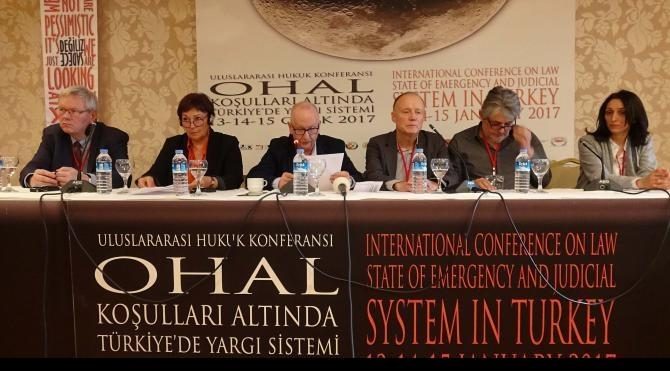
The ‘International Conference On Law, State of Emergency And Judicial System in Turkey’ was co-organized by different European lawyer organizations like: the AED (European Democratic Lawyers), the ELDH (European Association of Lawyers for Democracy and World Human Rights) and the Foundation Day of the Endangered Lawyer.

The conference was also co-organized by the European organization of judges MEDEL (Magistrats Européens pour la Démocratie et les Libertés). A great number of bar associations of cities in all corners of Turkey was co-organizer and had a big impact on the programme and organization of the conference.

The conference was held in Hotel Plaza in Ankara, where a lot of international colleagues were staying for the weekend.

This was a pleasant hotel with a very well-equipped conference room. There was no special security, except for one unarmed person at the entrance of the hotel. There was a huge interest from Turkish lawyers in the conference. They were coming from over 30 Turkish cities. There were 300/400 lawyers and judges taking part. 6 panels were organized with different speakers, who highlighted their specific subject. The subject of the speeches was the actual situation of the disappearing state of law in Turkey.

It was very different from other lawyer conferences. In this conference there was a lot of attention for the other professionals who are also endangered. There was a journalist panel, a judges panel, a panel of members of parliament. The panels of the journalists, judges and members of parliament and also the international panel and the Turkish lawyer panels have painted a very accurate picture of the actual situation and how the different professions are threatened and have to work in an atmosphere of fear and intimidation.

In the international panel I informed the public about the way the Dutch social lawyers association VSAN works and about the way of working of the Foundation Day of the Endangered Lawyer. I also invited the lawyers of the 30 Turkish cities to manifest themselves on the Day of the Endangered Lawyer for the general position of the lawyers and the attacks on the Rule of Law. I explained how the actual difficult situation in Turkey is seen by the politicians and press in Holland. During the congress I was in contact with a journalist of the Dutch newspaper Algemeen Dagblad a couple of times; he published a small interview with me on the internet (a copy of this interview is attached to this report). I was the only person from the Netherlands present on this international conference.

Because of the fear for tensions and possible problems for the organizors of the conference, I had informed and invited the Dutch embassy to take part in the conference. After a few contacts via e-mail we were able to establish a good working relationship with the second secretary of the embassy, who was present during the afternoon programme on the second day of the conference. I introduced him to a lot of judges and lawyers who represented the different Turkish bar associations and the international organizations. He was the only diplomatic visitor, which gave the conference an extra dimension, also from the point of view of safety.

The former German judge Ingrid Heinlein was also present at the conference. We had already been in touch with her in 2016, when the Day of the Endangered Lawyer focused on the difficult situation of the lawyers and judges in Honduras. This judge had taken part in a fact-finding human rights mission in Honduras two years ago. She has already been a member of the international European judges organization MEDEL for more than 20 years, and is also a member of the German ‘judges for judges’-association. I also contacted the Dutch foundation Rechters voor Rechters (Judges for Judges) about the Ankara conference. The president of this foundation had also thought about taking part in this conference.

During the conference, there were no real problems with the Turkish police or justice authorities, apart from one incident: the Italian lawyer Barbara Spinelli – who was going to speak at the conference – was stopped at the airport in Istanbul. They arrested her and made her spend one night imprisoned, before sending her back to Italy the next day. She was hindered in taking part in the conference, while she was one of the speakers of the international panel.

During the conference a lot of information was given to the lawyers and judges present. After the failed coup attempt 70.000/80.000 people were put in prison. Among them were 3007 judges and prosecutors and about 300 lawyers.

Detaining so many judges and lawyers is a very, very intimidating action for these professions and, in my view, it means the abrupt end of the Rule of Law in Turkey. We cannot possibly speak of an independent judicial system anymore, in which no political or other state power influences decisions. At the moment the government exercises extreme power over the judiciary. This is an unacceptable situation for a democracy.

Those present in the conference were told that many radio stations and television stations and newspapers were closed by the government. The speakers in the panels were under the impression that after the coup, many people were arrested arbitrarily and for not very logical reasons. Judges, lawyers and prosecutors were arrested randomly. Furthermore, at the conference it was said that the Turkish government didn’t do any serious investigation on the real perpetrators after the coup. It was even said that the investigation had already been closed or would close very soon.

At one lawyers office 7 lawyers were arrested. One of the people still representing this office gave me a small file with a request for help. The last remaining lawyer at this office – who had not yet been arrested – had to offer legal assistance to his own colleagues.

After being arrested, judges and lawyers are being kept in detention, according to their Turkish colleagues, in opposition to the rules of the European Convention on Human Rights and against the standards of the Turkish detention laws. Arrested lawyers and judges are not allowed to see a lawyer, and if they are, it is – in the best case – only half an hour per week. All contacts with their lawyer and with third parties are being recorded and monitored by police officers in prison. Official papers are being copied by the prison authorities. Besides that, lawyers are directly identified with their clients who are often accused of being part of the Gülen movement.

I was impressed by the very strong solidarity between all the lawyers coming from more than 30 Turkish cities from all over the country. The Turkish lawyers were very happy to have the support of the co-organizing European lawyer organizations and the organizations of judges. All the international guests were treated with big hospitality and personal support.

Among the many arrested lawyers and judges there are also many presidents from local bar associations and even from courts. The Turkish media who are pro-Erdogan and who are pro-the Turkish government are often accusing the arrested jurists of being terrorists, which makes it easier for the government to treat the arrested more severely and facilitates even more restrictions during their detention.

Since July 2016, the Turkish government has lifted c.q. suspended the working of the ECHR, by declaring a state of emergency and prolonging this afterwards. In Turkey groups and individual persons are often being accused of being a member of a criminal organization. Furthermore there have been many house and office searches in the homes and working places of arrested lawyers and judges. There have been many complaints about the treatment of people in detention. Many detained lawyers and judges complain about the fact that they were harmed psychologically and physically because the lights in their cells were on the entire night, so they couldn’t sleep. The detained lawyers and judges are often humiliated; they complained of being exposed in handcuffs in court houses.

There seems to be a situation of growing lawlessness, which is not only increasing for the arrested judges and lawyers, but also for those who have not yet been arrested.

We have been informed that the prosecution of judges and lawyers in Turkey is done with many faults and in a very careless manner. Many people are accused, without any real evidence or proof. Also, most of the times the actual exact accusation is very unclear. Often, it appears that the accusations are quite bizarre like undermining the state, doing terrorist acts or being a member of a criminal organization. Especially since the Turkish government has forbidden many, many organizations, also two well-known lawyer organizations, OHD and CHD, people can now be arrested quickly and be seen as an offender when they are a member of such forbidden lawyer organizations or active in such organizations.

The Turkish colleagues took very good care of their foreign colleagues. We were picked up and brought back to the airport and treated with a lot of hospitality.

From my contacts with many Turkish colleagues at the conference, it appears to me that many people are exhausted because of the continuous pressing political situation. It was clear that the colleagues are suffering because of this actual political situation. In Ankara, there was a lot of police on the street and it was no longer a town with atmosphere.

At the diner in the building from the bar of Ankara, the situation was quite different. After a very nice dinner, we heard people singing Turkish songs and dancing. After saying goodbye to our colleagues we took the bus to the airport and left with mixed feelings. We were leaving while they had to continue living in this difficult situation.

Hans Gaasbeek

International coordinator of the Day of the Endangered Lawyer, president of the Foundation Day of the Endangered Lawyer and vice president of the Dutch League of Human Rights

« Le système judiciaire sous l’état d’urgence, en Turquie »

Mes Chers confrères,

Comme vous le savez, je me suis rendue à ANKARA les 13, 14 et 15 janvier dernier, pour participer à une conférence internationale portant sur conférence organisée par 22 Barreaux turcs (entre autres Ankara, Adana, Antalaya et Diyarbakir), l’AED, la Fondation de la  Journée de l’Avocat Menacé, l’ELDH et le MEDEL avec le soutien de quelques organisations internationales européennes et Barreaux.

J’étais en compagnie de Robert SABATA, secrétaire général de l’AED, de Jean-Philippe DE WIND, membre du SAD et de Hans GAASBEEK du VSAN et de la Fondation de la Journée de l’Avocat Menacé.

A titre d’information, je joins à la présente le texte de présentation de la conférence, la liste de participants, le communiqué de presse et les différents thèmes qui ont été abordés.

C’est en qualité de Présidente de l’AED que j’ai été amenée à intervenir dans ce colloque, tant en ouverture de séance, que sur deux tables rondes, ainsi que lors de la conférence de presse qui a été organisée par nos confrères turcs.

Il s’agissait pour nous, participants étrangers, de marquer notre solidarité avec les confrères, magistrats, journalistes et députés qui, depuis que l’état d’urgence a été déclaré en juillet dernier, vivent des moments particulièrement difficiles, subissant des arrestations arbitraires, des séquestrations, des destitutions, des tortures, pour des faits de terrorisme qui n’ont absolument rien à voir avec la réalité de leurs activités.

Entre 200 et 300 personnes étaient présentes pendant ces trois jours de travaux et je ne peux que louer le courage des ces différents participants dont de nombreux bâtonniers, confrères, juges, parquetiers, journalistes, enseignants et parlementaires, qui du simple fait de leur présence lors de cette rencontre se sont exposés durablement.

Je dois signaler que l’une de nos consœurs italiennes, Barbara SPINELLI, qui devait participer à la conférence pour le compte de l’ ELDH, a été empêchée d’entrer sur le territoire turc, retenue à la frontière à Istanbul et expulsée vers l’Italie, en raison du fait qu’elle a, par le passé, assuré la défense d’accusés kurdes.

Les témoignages que nous avons pu entendre sont accablants quant à l’irrespect total de l’état de droit en Turquie. Des confrères sont arrêtés pour avoir défendu leur clients ; des magistrats sont arrêtés ou destitués pour avoir tenté de dire le droit ; des journalistes sont arrêtés ou licenciés pour avoir été présents sur le lieu d’évènements considérés comme contraires au régime ; des parlementaires sont insultés et brutalisés dans l’hémicycle…

Le Président Erdogan a maintenant pris la décision de changer la constitution turque pour installer un régime présidentiel à la place du régime parlementaire. Pour cela il fait voter les modifications par un parlement totalement réduit à néant puisque l’ensemble des députés susceptibles de s’opposer à son projet ont été, soit incarcérés, soit destitués. Il faut faire une mention spéciale pour les MP du HPD qui poursuivent la mise en place d’un processus de paix au Kurdistan. La légalité démocratique et l’État de Droit sont sur le point de disparaître en Turquie.

Cette conférence était d’une grande importance pour les juristes turcs attachés aux valeurs de la démocratie, et la présence d’organisations étrangères leur a permis de se sentir moins isolés, sans pour autant, soyons en conscients, leur accorder une véritable protection pour l’avenir.

Il nous faut donc être particulièrement vigilants pour eux.

Pour finir, je souhaite remercier les confrères turcs pour la qualité de l’organisation de cette conférence.

En tout cas, ils nous ont donné une belle leçon de courage.

State of Emergency and Judicial System in Turkey

We greet you as organizers of the conference entitled “State of Emergency and Judicial System in Turkey”.

This conference has historical significance, for the following reasons:.

● The conference is organized in Ankara, the capital of Turkey, in an environment dominated by the oppressive and coercive practices of the State of Emergency in Turkey.
● The conference brings together lawyers, judges and prosecutors. Together they are the foundations of judicial system. There is also a place for academics, who have crucial importance for the production of legal interpretation and knowledge; for journalists whose importance is undeniable in the distribution of information; and also for parliamentarians. All significant actors who can discuss the impacts of the State of Emergency on the judicial system in Turkey are present at this conference.
● The significance of this conference is not limited to Turkey .​ ​Today no one can claim that the political and economic problems of any location are unique to that location. Whether these problems concern the State of Emergency, martial law, anti-terror practices, deterioration of the judicial system, democracy, or access to justice. Regardless of their severity and location, they are all our shared problems.​ With ​this perspective, this conference is a conference where international experiences can be shared, discussed and put together in proposals for a solution.
● This conference is not just a transfer of information. This conference is a tool for analysis, diagnosis and plans for the future.

It is precisely for these reasons that this conference has a historical significance. The conference is held at a time when thousands of Turkish judges and prosecutors are in custody, and thousands who are still at liberty, are fettered by the fear of imprisonment , and in fact live in an environment where they have lost their independence. The slightest criticism is persecuted through the apparatuses of oppression and coercion.

The location and the date of the conference are not a coincidence, but a product of conscious choice. We hope that this conference is going to become a means of struggle for the peoples of Turkey and the world.

Turkey has already ceased to be a state governed by the rule of law. In a country where judges are deprived of the power of independent decision-making and where lawyers are not allowed practise their profession, it is not possible to talk about the principle of the rule of law nor about a real judicial system. This is because the judicial system is not the sum of procedural rules. The only valid diagnosis for a state of affairs in which the right to access to justice is restricted, or the right to a fair trial is blocked, is that lawlessness and arbitrary rule have replaced the rule of law.

An examination of the current Constitution of the Republic of Turkey and the State of Emergency Law shows us the following;

● The scope of the State of Emergency and the way it was declared are unlawful in themselves.

  •  The Decree Laws issued behind the curtain of the State of Emergency are unlawful.
  •   The dismissals and the privatizations of and the bans of the associations, newspapers and the TVs through the Decree Laws are unlawful.

● Any kind of parliamentary activity and all kinds of interventions carried out in the context of the Constitutional amendment during the State of Emergency period are unlawful.

In essence, there has not been a single step that can be described as lawful since the declaration of the State of Emergency in Turkey. On the contrary, under the cover of anti-terrorism, judges, lawyers, journalists, academics, and anyone who raises a voice in the face of the presidential regime under construction in Turkey today, are arrested, and subjected to inhumane treatment during detention . Today, an issue such as a constitutional amendment, which should require a the agreement of the whole of society , has been forced onto the agenda under the conditions of the State of Emergency, and the country is being dragged into a state of irreversible regime change. .

We, as lawyers from many countries of the world, declare that we are concerned about this dangerous course. Our commitment to the rule of law tells us that this trend is not unique to Turkey, and we want to share our experiences as well. War, martial law, dictatorship, State of Emergency are all legal guises of oppression and coercion. In short, all these can be described as the dark side of the moon, which was always there even before they were declared.

Today and here, we are bringing together the experiences of those who look at the dark side of the moon. But more importantly, we are building the knowledge of hope. Law is an area of ​​struggle for rights and freedoms, not just for its subjects, but for all societies. With this consciousness, we inform the public of the whole world that we will not remain silent in the face of what is going on in Turkey today and that we will make our stand against this darkness!

In Turkish newspapers:

http://www.sozcu.com.tr/2017/gundem/son-dakika-haberi/dunya-capinda-348-gazeteci-cezaevinde-bunlarin-143u-turkiyede-1625031/

http://www.dihaber.org/TUM-HABERLER/content/view/6404

The judicial system under the state of emergency in Turkey

The Judicial System under the State of Emergency in Turkey is an international conference, which will be held on the 14th and 15th of January 2017 in Ankara, at the Ankara Plaza Hotel, Kavaklidere Bestekar Sk. No: 5 06680 Çankaya.

The conference is organized by the:

• European Association of Lawyers for Democracy and World Human Rights, www.eldh.eu
• European Democratic Lawyers, https://www.aeud.org/
• International Association of Democratic Lawyers, http://www.iadllaw.org/newsite/
• The Day of the Endangered Lawyers Foundation, http://dayoftheendangeredlawyer.eu
• Together with the 19 Bar Associtions of the following Turkish cities: Ankara, Adana, Adiyaman, Agn, Antalya, Batman, Bingöl, Bitlis, Diyarbakir, Hakkari, Igdir, Kars-Ardahan, Mardin, Mus, Siirt, Sanliurfa, Sirnak, Tunceli, Van (some other Bar Associations in Turkey will suport the conference.)
• and judges’ Associations: Democratic Judges, The Syndicat of Judges
• The platform of Lawyers against State of Emergency: The platform of 11 different lawyer group


and has the following program

14.01.2017 – SATURDAY

Opening: Bill Bowring, The President of ELDH – Pascale Taelman – The President of EDL-AED

09.30-10.45 The rights, duties and the repression faced by Bar Associations and their members under State of Emergency

Moderator: Mengücek Gazi Çıtırık

Speakers: Ahmet Özmen – The president of Diyarbakır Bar Association, Hakan Canduran – The president of Ankara Bar Association, Polat Balkan– The president of Antalya Bar Association, Veli Küçük – The president of Adana Bar Association, Gürkan Altun – The president of Bursa Bar Association, Robert Sabata – Barcelona Bar Association

11.15 – 13.00 Under the State of Emergency: The guarantee for the independence and impartiality  of Judges

Moderator: İlhan Cihaner / Murat Aydın

Speakers: Orhan Gazi Ertekin, Leyla Tarhan Köksal, Mustafa Karadağ, Ingrid Heinlein

LUNCH (13.00 – 14.00)

14.00 – 15.45 State of Emergency and the Media

Moderator: Gökçer Tahincioğlu

Speakers: Zeynep Yüncüler, Erdem Gül, Cem Gurbetoğlu, Kenan Kırkaya

16.00 – 17.45 Being of a lawyer under the State of Emergency

Moderator: Ayşe Acinikli

Speakers: Selçuk Kozağaçlı – ÇHD, Özgür Erol – ÖHD, Thomas Schmidt – ELDH, Pascale Taelman – AED, Hans Gaasbeek – Day of the Endangered Lawyer Foundation, Jan Fermon – IADL, Barbara Spinelli – ELDH/GD

15.01.2017 -SUNDAY

09.30 – 10.45: The legislative prerogative under the state of emergency and parliamentary immunity

Moderator: Ali Haydar Hakverdi

Speakers: Meral Danış Beştaş, Şenal Sarıhan, Filiz Kerestecioğlu, İlhan Cihaner, Mithat Sancar

11.00 – 13.00: Practices of Anti-Terror, State of Emergency and State of Siege in Turkey and in the World.

Speakers: Berke Özenç, Şebnem Korur Fincancı, Cihan Aydın, Clemens Lahner – ELDH, Florian Borg – AED


The CHD has been banned in Turkey

Here is the Press statement of our German colleagues from the RAV:


On the 11th of November 2016, the Turkish Ministry of Interior, in the context of the state of emergency, has banned 370 organizations and associations in Turkey. It has further set, inter alia, a three-month ban on the freedom of the advocacy for lawyers: the ÇHD (Çağdaş Hukukçular Derneği), the lawyers ‘association ÖHD (Özgürlükçü Hukukçular Derneği) and the Mesopotamian lawyers’ association MHD (Mezopotamya Hukukçular Derneği). Their business premises were sealed. In addition, several lawyers were arrested under massive use of force. The government relies on Article 11 of the Exemption Act and justifies the ban with its responsibility for national security.


The opposite is the case:

In fact, ÇHD, ÖHD, and MHD are legal associations that have been advocating the enforcement of human and civil rights in Turkey for decades. ÇHD and ÖHD are members of the ‘European Association of Lawyers for Democracy and Human Rights in the World’ (EJDM / ELDH1). The ÇHD is also, as the RAV, a member of the umbrella organization of European democratic lawyers (EDA / AED). In 2014, the ÇHD was awarded the Kant-Weltbürger-Preis by the Freiburger Kant-Stiftung and the VDJ the Hans-Litten-Prize4 for its commitment to human rights and democracy. They support the rights of minorities, the fight against torture and human rights violations in Turkey, not least through successful complaints to the European Court of Human Rights.


With these unlawful attacks on ÇHD, ÖHD and MHD, the Turkish government violates the fundamental right of freedom of association and the basic principles of free advocacy, as they were adopted by the United Nations in 1990 as “Basic Principles on the Role of Lawyers”. If lawyers cannot act for the interests of their clients for fear of persecution, there can be no question of the existence of a legal state.

Erdoğan is set to destroy what is left of oppositional civil society in Turkey.


We strongly condemn these unlawful attacks on our colleagues and demand the immediate release of all imprisoned lawyers and the immediate termination of the state of emergency and the ensuing repression.


With the imposition of the state of emergency, following the coup attempt on 15 July 2016, the Turkish government has systematically abolished the rule of law and democracy. With the dismissal of thousands of judges, state officials, teachers and academics, the closure of free media and the arrest of thousands of people, including parliamentary deputies, with the pretext of combating terrorism, Erdoğan’s is making it very clear: It is not about securing, but about abolishing democracy.


This can be illustrated by some of the changes, obtained by governmental decrees, with regard to the rights of the defence, after the imposition of the state of exception:

– Accused can be held for up to 5 days in incommunicado detention, thus without right to contact a lawyer

– The accused can be held in custody for 30 days without having to be prosecuted

– Visits of the defenders to their detained clients may be prohibited for a period of up to 6 months

– All discussions between imprisoned accused and their defenders are to be filmed and monitored by the prison staff

– All defence documents can be confiscated, even without judicial decision

– Defenders can be searched in detention during visits of their clients, even physically.

– Law firms can be searched without a search warrant and the documents of the client seized


There, where the population is intimidated and silenced by mass-dismissals, prosecution, detention, torture and deprivation of rights, there is no basis for any democracy. There, where lawyers are not allowed to do their work, the state of law is something from the past.


The Federal Government cannot close its eyes before this development.

Our solidarity is open to all those who advocate democracy, human rights and freedom in Turkey.

Another lawyer under threat in Turkey

To: ANTALYA CHIEF PUBLIC PROSECUTOR’S OFFICE

(ANTALYA CUMHURİYET BAŞSAVCILIĞI’NA)

2016/69739 No.

Fax Number: + 90 242 237 11 11 (Turkey)


Créteil, Barcelona and Amsterdam, October 24, 2016.

European Democratic Lawyers (AED-EDL) are very concerned about the news that the former director member of ÇHD Antalya – Çağdaş Hukukçular -Progressive Lawyers Association, the advocate Özden SALDIRAN was arrested 9 days ago, on the 15th of October. His home and office were searched. She’s still in police station and has not yet been sent to the courthouse.

Ms. Özden SALDIRAN is suffering from diabetes and high blood pressure. Without medical care the police custody may endanger her health.

It is clear that Özden Saldıran has no connection with FETÖ. The arrest of lawyer Özden SALDIRAN is another case against lawyers simply because they perform their professional duties. This arrest is part of a pattern of prosecutions for alleged terrorist offenses that the Turkish government brings against its citizens, including journalists, trade unionists, human rights activists, parliamentarians, academics and students who are committed to a peaceful resolution of the Kurdish issue and freedom of expression.

Since the government started operations giving as their reason the fight against the called Fethullahist Terrorist Organization (FETÖ), it is clear that they are using this as a pretext for oppression of organisations and individuals who have definitely no connection with FETÖ.

ÇHD is our partner in the struggle for the defence of Humans Rights. Since 1974, it has campaigned for respect and defence of human rights and the defence of oppressed peoples in Turkey. This is not the first case of government attacks against the dissidents. The trial of 22 other senior members of ÇHD has been underway since 2013. .

AED-EDL strongly condemns the arrest and detention of lawyer Özden SALDIRAN and demands her immediate release and the end of all unjustified persecution. AED-EDL demands furthermore that the Turkish government respects the professional work and role of lawyers, and complies in particular with Article 9 of the International Covenant on Civil and Political Rights as well as Article 16 and 18 of the UN Basic Principles on the Role of Lawyers.

Statement regarding the attack on the lawyer Günay Dag

The member of the Istanbul branch of ÇHD, lawyer Günay Dag, was subjected to torture a few days ago by guards of Maltepe juvenile’s prison acting under the orders of the prison governor while visiting one of his clients. His head was rammed against the wall and on the ground and as a result his fingers and head were injured. Afterwards he was dragged out of the prison on the floor.

It is worth remembering that Lawyer Günay Dag had gone to the prison to investigate the alleged torture of child detainees.

Obviously, even if there is a state of emergency (Decree having force of Law concerning the emergency measures – Decree Decision Number: KHK /667) the individuals’ rights must be inviolable (As amended on May 7, 2004; act 5170: Even under these circumstances the individual’s right to life, the integrity of his/her physical and mental existence shall be inviolable….) and the Article 17 of the Turkish Constitution says:

……No one shall be subjected to torture or mal-treatment; no one shall be subjected to penalties or treatment incompatible with human dignity.

It is evident that if lawyers cannot do their jobs in Turkey, it means that more children and more young people will be arrested because of their speech and thoughts and many people will be faced with torture. So this is not just a fight for the lawyers’ rights but is a fight for democracy and freedom, as defined by the case law of the ECHR. Nowadays we are facing a long-running attempt by the Turkish government to stifle human rights activism.

Our organisations work on the base of The Basic Principles on the Role of Lawyers which have been adopted by the 8th congress of the United Nations in Havana (Cuba) between 27 August and 7 September 1990, which principles contain the following:

Whereas adequate protection of the human rights and fundamental freedoms to which all persons are entitled, be they economic, social and cultural, or civil and political, requires that all persons have effective access to legal services provided by an independent legal profession,

Whereas professional associations of lawyers have a vital role to play in upholding professional standards and ethics, protecting their members from persecution and improper restrictions and infringements, providing legal services to all in need of them, and cooperating with governmental and other institutions in furthering the ends of justice and public interest,

The Basic Principles on the Role of Lawyers, set forth below, which have been formulated to assist Member States in their task of promoting and ensuring the proper role of lawyers, should be respected and taken into account by Governments within the framework of their national legislation and practice and should be brought to the attention of lawyers as well as other persons, such as judges, prosecutors, members of the executive and the legislature, and the public in general. These principles shall also apply, as appropriate, to persons who exercise the functions of lawyers without having the formal status of lawyers.

And establish the following guarantees:

  1. Governments shall ensure that lawyers (a) are able to perform all of their professional functions without intimidation, hindrance, harassment or improper interference; (b) are able to travel and to consult with their clients freely both within their own country and abroad; and (c) shall not suffer, or be threatened with, prosecution or administrative, economic or other sanctions for any action taken in accordance with recognized professional duties, standards and ethics.
  2. Where the security of lawyers is threatened as a result of discharging their functions, they shall be adequately safeguarded by the authorities.

Likewise the Recommendation (Council of Europe) No. R(2000)21 of the Committee of Ministers to member States on the freedom of exercise of the profession of lawyer sets the minimums of protection that are not being followed by the Turkish State.

As jurists we cannot accept this harassment of our colleague. Sadly, there is a long tradition of attacking the defence in Turkey. We must prevent the development of intimidation against lawyers and humans rights defenders.

This is why, in this situation the AED-EDL, the ELDH and the Foundation of the Day of the Endangered Lawyer condemn the actions against the civil and political rights of its citizens and lawyers occurring in Turkey by way of the use of state powers. And so:

I.- We call on our colleagues, friends, democrats, the chairman of the Turkish Union of Bar Associations and all chairmen and board members of the Bar Associations throughout Turkey to show solidarity with the lawyer Günay Dag.

II.- We demand that the governor and the prison guards must be investigated concerning these facts and prosecuted if necessary.

III.- We call upon the Turkish government to stop these practices against human rights defenders and lawyers.

IV.- Finally, we invite the Union of Bar Associations of Turkey to break its silence regarding the increasing attacks on lawyers and we invite the Istanbul Bar Association to support its member.

Harlem, Créteil, London, 16th October 2016.


schermata-2016-10-21-alle-18-04-45

Le déficit démocratique aujourd’hui en Turquie:

Des autocrates au pouvoir et de la répression.

Dès le 15 juin dernier plus de 40.000 personnes sont en prison, d’entre les 100.000 détenus à cause d’un Coup d’État qui reste une énigme politique de premier ordre. Actuellement on peut dire que :

Il existe une manipulation de tout mass media et la fermeture de maints journaux, radios, télévisons : donc, pas d’opposition médiatique aux consignes antidémocratiques et tyranniques des pouvoirs publics.

Les attaques aux parlementaires et aux maires de l’HDP et (parti Démocratique des Peuples) sont évidents.

Ainsi que les purges de fonctionnaires (3000 licenciés et 40.000 en attente de l’être).

Il existe des groupes paramilitaires et parapoliciers qui commencent à agir de partout.

Les Modifications urgentes du Procès pénal pour empêcher le libre exercice de la défense (s’il existait déjà avant le coup d’État) sont une réalité.

Les procès pénitentiaires ont été modifiés. La torture est très généralisée en prison et en garde-à-vue.

La mort civile des opposants moyennant la « freeze assets » complet qui leur fait impossible de même s’alimenter. Les passeports sont retirés aux suspects et à leurs familles qui deviennent ainsi des otages politiques.

Du point de vue du Droit de la défense la situation s’aggrave de jour en jour. Le Conseil Supérieur des Juges et Procureurs (HSYK) continue a être choisi/élu par le pouvoir exécutif, ce qui suppose un brisement du principe de la division des pouvoirs de l’État. Ce Conseil terrorise les Juges ou Magistrats qui ne suivent pas ses consignes politiques en prenant tout genre de représailles contre eux, en une attaque directe contre l’indépendance du pouvoir judiciaire. Viendra le tour des défendeurs des DH qui ont toujours subit une attention “spéciale” des pouvoirs politiques en Turquie.

Le Magistrats et les Avocats doivent faire face au péril de confrontation civile en Turquie. Le 29 octobre la ÇHD (Association de Avocats Progressistes en Turquie) tiendra une conférence à Izmir avec des associations de Magistrats pour analyser la situation et chercher des complicités qui apparaissaient difficiles auparavant.

Et finalement, les populations kurdes et les minorités nationales, culturelles ou religieuses souffrent de plus en plus et toujours la répression, le meurtre et l’oubli de l’Europe, enfermée dans son bastion aveugle face aux crimes contre l’humanité qui se produisent chaque jour au sud-est et ailleurs en Turquie.

Aussi face à cette situation l’AED condamne les actuations du Gouvernement turc limitant et contre les Droits Civils et politiques de ses citoyens et condamne de même les crimes contre l’Humanité qui se produisent en Turquie sous le paravent des pouvoirs étatiques.

Barcelona, Bruxelles, Paris, Madrid, Berlin, Rome, Milano, Bilbao, Amsterdam

10 Octobre 2016

AED/EDL (Avocats Européens Démocrates / European Democratic Lawyers)

Membre adhéré en Turquie: ÇHD – Çağdaş Hukukçular Derneği (Association de Avocats Progressistes) / www.chd.org.tr

Statement on the possible reinstatement of the death penalty in Turkey

The right to life is guaranteed by all major international and regional human rights treaties. The European Court of Human Rights has interpreted the right to life as “an inalienable attribute of human beings” and a “supreme value in the international hierarchy of human rights”.[1]

The undersigned organisations believe that the abolition of the death penalty contributes to the fostering and protection of human dignity and the gradual development of a global culture of human rights.

The undersigned therefore condemn, in the strongest terms, any attempt to reinstate the death penalty in Turkey.

The undersigned insist on the fact that Turkey is a member of the Council of Europe and a signatory of the European Convention on Human Rights. Consequently, Turkey is bound by Protocols 6 and 13 of the Convention which abolish the death penalty. In Turkey, the last execution took place in 1984. The death penalty was abolished for ordinary crimes in 2002, and finally abandoned on 7 May 2004. In addition, in 2006, Turkey became the 57th State to ratify the Second Optional Protocol to the International Covenant on Civil and Political Rights, aiming at the abolition of the death penalty.

Therefore, the undersigned call upon the Turkish government to respect its international commitments, reminding them that Turkey has supported the recent World Congress Against the Death penalty held on 21-23 June 2016 in Oslo.


Council of Bars and Law Societies of Europe (CCBE)

International Association of Lawyers (UIA)

European Bars Federation (FBE)

International Association of Young Lawyers (AIJA)

European Democratic Lawyers (AED)


[1] European Court of Human Rights, Judgment in the case of Streletz, Kessler and Krenz v. Germany, 22 March 2001, in particular paragraphs 72, 85, 87 and 94.


—-

Le droit à la vie est garanti par tous les traités internationaux et régionaux importants sur les droits de l’homme. La Cour européenne des droits de l’homme a interprété le droit à la vie comme un « attribut inaliénable de la personne humaine » et « la valeur suprême dans l’échelle des droits de l’homme sur le plan international »[1].


Les organisations signataires sont convaincues que l’abolition de la peine de mort contribue au renforcement et à la protection de la dignité humaine et au développement progressif d’une culture mondiale des droits de l’homme.


Elles condamnent dès lors, de la manière la plus ferme, toute tentative de rétablir la peine de mort en Turquie.


Les organisations signataires insistent fortement sur le fait que la Turquie est membre du Conseil de l’Europe et signataire de la Convention européenne des droits de l’homme. Par conséquent, la Turquie est tenue de respecter les Protocoles 6 et 13 de la Convention qui abolissent la peine de mort. La dernière exécution ayant eu lieu en Turquie remonte à 1984. La peine de mort a été abolie pour les crimes de droit commun en 2002, avant d’être finalement abandonnée le 7 mai 2004. Par ailleurs, la Turquie est devenue en 2006, le 57État à ratifier le deuxième protocole facultatif se rapportant au Pacte international relatif aux droits civils et politiques, visant à abolir la peine de mort.


Elles appellent le gouvernement turc à respecter ses engagements internationaux et rappelle que la Turquie a soutenu le récent Congrès mondial contre la peine de mort qui s’est tenu à Oslo du 21 au 23 juin 2016.

[1] Arrêt du 22 mars 2001 de la Cour européenne des droits de l’homme dans l’affaire Streletz, Kessler et Krenz c. Allemagne, en particulier les paragraphes 72, 85, 87 et 94.